
Factor Xa (FXa) plays a key role in the coagulation cascade and constitutes a major therapeutic target of anticoagulant therapies. Assessing anti–FXa activity is widely used in patients receiving anticoagulants exhibiting Anti-Xa activity.
Hemostasis relies on a finely regulated dynamic balance between procoagulant and anticoagulant mechanisms, ensuring vascular integrity by preventing both bleeding and excessive clot formation.
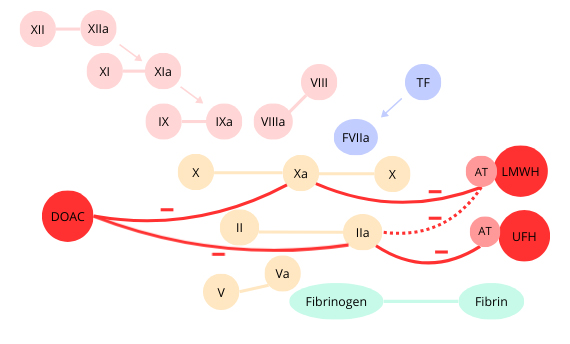
Coagulation cascade
Prevention and treatment of thromboembolic events rely on anticoagulant therapy administered either parenterally - unfractionated heparin (UFH) and low-molecular-weight heparins (LMWHs) - or orally, including vitamin K antagonists (VKAs) and direct oral anticoagulants (DOACs). Heparins exert their anticoagulant effect by binding to antithrombin and enhancing its inhibitory activity against FXa and thrombin (factor IIa) (Elalamy 2010).
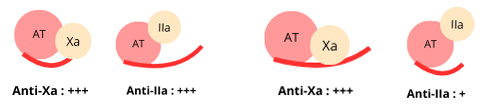
Anticoagulant effect of heparins
Direct oral anticoagulants (DOACs) selectively inhibit a single coagulation factor.
Namely FXa in the case of apixaban, edoxaban, and rivaroxaban.
Historically, activated partial thromboplastin time (aPTT) was used to monitor UFH therapy because it is rapid, simple, cost-effective, and widely available. However, it lacks specificity, being affected by factor deficiencies, inflammation, reagent type, and circulating anticoagulants, which can lead to biased results and inappropriate clinical decisions. Consequently, aPTT is no longer recommended for routine heparin monitoring.
Anti-Xa activity measurement is now preferred due to higher specificity and reduced interference. The assay is sensitive to heparin, standardized with international standards, and to direct Anti-Xa drugs, and provides reliable, reproducible monitoring (Dingus et al., 2022).
Anti-Xa activity is mainly measured using a chromogenic assay, in which excess FXa is added to plasma. The anticoagulant neutralizes part of the FXa, and the residual enzyme cleaves a chromogenic substrate, producing a signal inversely proportional to anticoagulant concentration (Siguret & Delrue, 2022).
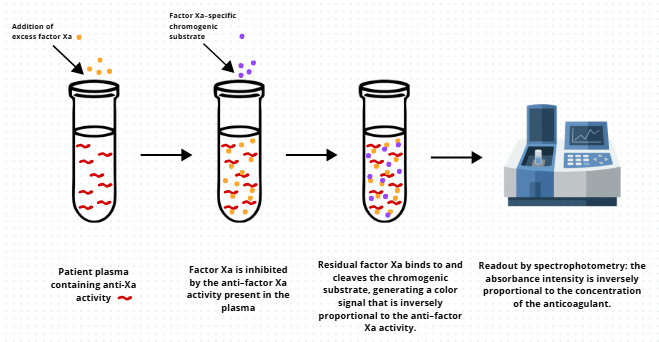
Chromogenic assay for Anti-Xa activity
Some important assay features should be regarded for the measurement of Anti-Xa activity:
- Anticoagulant-specific calibration: calibration curves differ depending on the anticoagulant under investigation and are not interchangeable.
- Therapeutic overlap (heparin and DOACs): In cases of concomitant therapy, the measured signal reflects the overall anti-Xa activity resulting from the combined effects of the agents present.
- Analytical interferences: hyperbilirubinemia, hemolysis, or significant lipemia may affect assay performance.
- Timing of sampling: The interval between drug administration and blood sampling is a critical parameter for result interpretation.
- Inter-reagent variability: Several factors may contribute to variability between reagents:
- The presence of dextran sulfate can dissociate UFH–plasma protein complexes formed in vivo (e.g., during inflammation or heparin reversal with protamine), potentially increasing apparent Anti-Xa activity and affecting clinical decisions. In vitro, heparin neutralization may slightly reduce measured Anti-Xa activity during sampling when no dextran sulfate is added to the reagent, but this effect is generally minimal and not clinically relevant (Hardy et al., 2023). An ISTH SSC recommendation on the use of reagents containing or not dextran sulfate is expected in the near future.
- The use of CTAD tubes, which helps prevent artifactual inhibition of factor Xa at the time of sampling (Savard et al., 2025).
- The origin of factor Xa (human or bovine).
- The presence or absence of antithrombin in the reagent. An ISTH SSC recommendation on the use of reagents containing or not antithrombin is expected in the near future.
- The use of single or hybrid calibration strategies.
- The type of chromogenic substrate used.
Anti-Xa measurement is essential for monitoring and adjusting anticoagulant therapy
Its results can be affected by various analytical and pre-analytical factors; using the appropriate method and controlling these variables is crucial for reliable interpretation and optimal patient management.

| Learn more about STA Liquid Anti-Xa  |