


From aPTT to Anti-Xa: the method of choice
While aPTT has long been the standard, well-documented evidence highlights its limitations. Multiple factors, both analytical and clinical, compromise the reliability of the aPTT:
• Acute-phase response: Inflammation, elevated Factor VIII, or elevated fibrinogen.
• Biological interferences: Presence of a lupus anticoagulant.
• Inter-reagent variability: A lack of standardization that complicates interpretation.
In patients with sepsis, post-surgery, or COVID-19, Factor VIII and Fibrinogen spike. This artificially shortens the aPTT. The lab reports a "normal" result despite high heparin levels, leading clinicians to overdose the patient (1,2).
Anti-Xa offers a direct, specific, and safer measurement for the patient.
ISTH guidance strengthens the role of anti-Xa for UFH monitoring.
The latest ISTH guidance supports a clear direction for laboratories: move from aPTT to anti-Xa for UFH monitoring, and use an anti-Xa assay without dextran sulfate for a more appropriate assessment of UFH activity.

| aPTT (Historical) | Anti-Xa (Modern Standard) | |
| Specificity | Low – influenced by FVIII, FXII, lupus anticoagulant, inflammation, and liver function. | High – specifically targets anti-Xa inhibitors; not influenced by acute phase proteins or common factor deficiencies. |
| Sensitivity | Highly variable depending on reagent/instrument. | High sensitivity to heparin with consistent analytical performance. |
| Therapeutic Range | Must be recalibrated for each reagent lot; stability depends on reagent sensitivity. | Fixed and internationally recognized range (0.3–0.7 IU/mL); does not change with lot. |
| Quality Control | Lack of international standard traceability. | Traceable to international standards. |
Beyond clinical safety, the switch to Anti-Xa is a cost saving assay (4, 5, 6, 7):
- Shorter hospital stays from 25 days using a PTT to 17 days using Anti-Xa method.
- Therapeutic range reached in 48 h in 100% of cases.
- Reduced number of assays per day to adjust treatment.
All Anti-Xa tests are not equal - dextran sulfate matters
To ensure physiological reality, you must look at the reagent formulation—specifically the presence of dextran sulfate (DS).
DS (dextran sulfate) is added to some reagents to prevent heparin from binding to plasma proteins (like PF4) in the tube. While this measures total heparin, it fails to reflect the active heparin actually working inside the patient.
| Reagent Formulation | Status Post-Protamine | Clinical Decision Impact |
| Without DS | Accurate (Low/Undetectable) | Confirms successful reversal |
| With DS | Inaccurate (Falsely High) | Risk of unnecessary extra Protamine |
What this means for your lab?
Recent multicenter data confirms that DS creates significant variability. To measure physiological reality, choose an Anti-Xa reagent without DS (3).
Stago STA-Liquid Anti-Xa, a reageant to monitor heparin without dextran sulfate
Stago is committed to providing a comprehensive range of anticoagulant measuring solutions. With STA-Liquid Anti-Xa, a polyvalent reagent, liquid and ready-to-use, start a journey to monitor heparin without dextran sulfate.
| 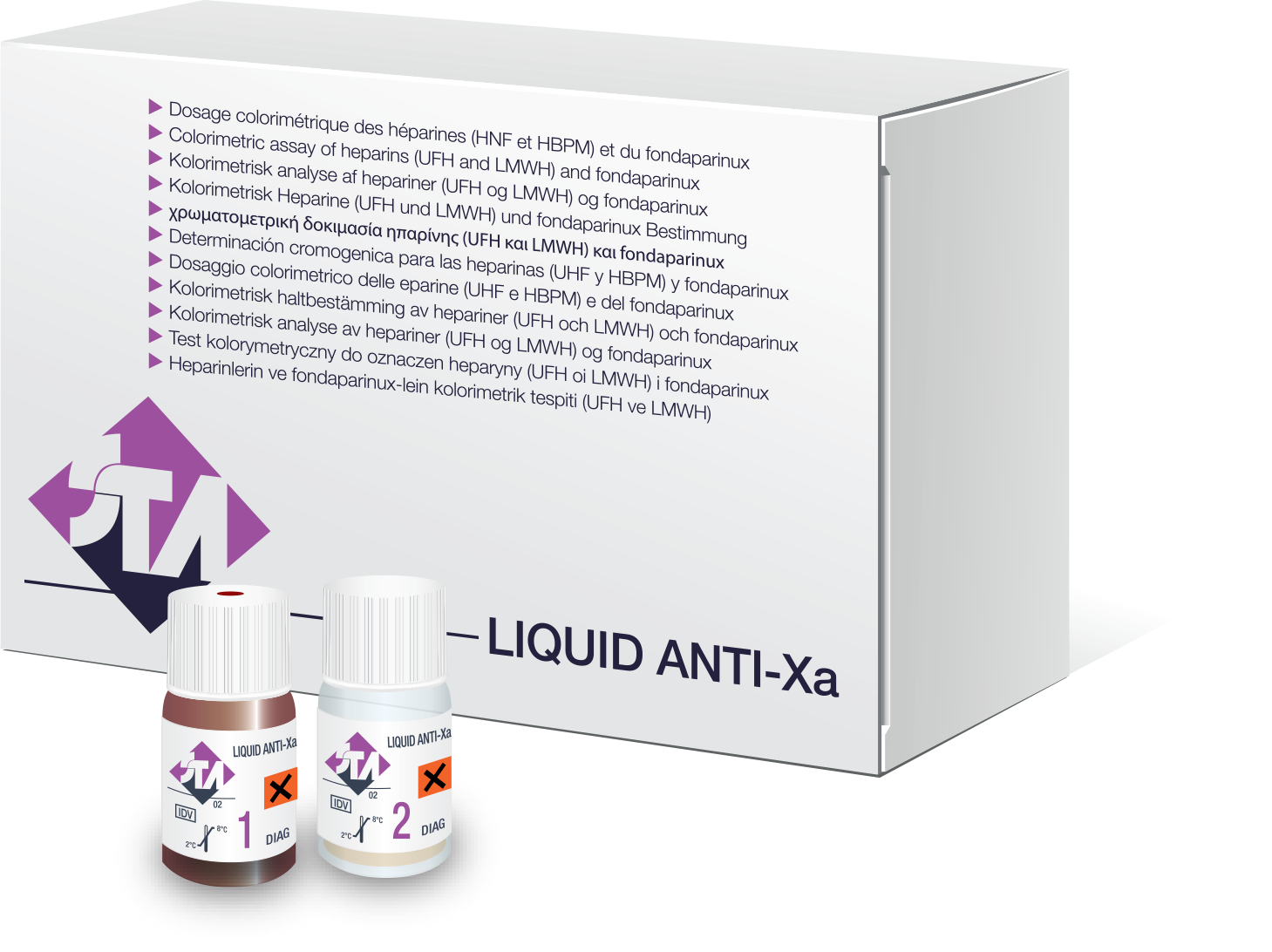 The STA-Liquid Anti-Xa is used for the quantitative determination of anti-Xa activity. |
| Repeatability CV (%) | Within-laboratory precision -CV (%) | |||
| Low level | High level | Low level | High level | |
| LMWH | 3.0 | 3.8 | 3.5 | 4.8 |
| UFH | 5.9 | 2.6 | 7.2 | 4.5 |
| Fondaparinux | 3.5 | 2.6 | 3.3 | 2.3 |
| Rivaroxaban | 2.5 | 1.9 | 3.3 | 2.8 |
| Apixaban | 3.9 | 2.0 | 4.3 | 2.6 |
| Edoxaban | 2.8 | 2.0 | 6.0 | 4.4 |

STA-Liquid Anti-Xa, STA R Max, STA Compact Max are trademarks of the Stago Group. The rights of the trademarks and logos used in this document belong to the Stago Group. The use of these trademarks is not permitted without permission from the Stago Group. The STA - Liquid Anti-Xa is used for the quantitative determination of anti-Xa activity. Please refer to the IFU.
To learn more about Anti Xa and Heparin
- Download the Stago Anticoagulant Line brochure.
- Anti-Xa Monitoring: Evolution of Practices.
- Listen to Ask Stago podcasts :
- Watch the Stago webinar on heparin monitoring.
References
(1)Marlar RA, and al. Semin Thromb Hemost. 2017
(2) Favaloro EJ, and al. Pol Arch Intern Med. 2024
(3) Lasne D, and al. Thromb Haemost. 2023
(4) Guervil DJ, Rosenberg AF, Winterstein AG, Harris NS, Johns TE, Zumberg MS. “Activated Partial Thromboplastin Time versus Antifactor Xa Heparin Assay in Monitoring Unfractionated Heparin by Continuous Intravenous Infusion.” The Annals of Pharmacotherapy 45, no. 7–8 (2011): 861–68.
(5) Gearhart A, Dorman N, Scott D, Rahman O. “Time to Therapeutic Levels: Comparison of the Anti Xa Assay vs Ptt in Critical Care.” Chest 140, no. 4_MeetingAbstracts (2011): 286A–286A.
(6) Van Roessel S, Middeldorp S, Cheung YW, Zwinderman AH, de Pont AC. “Accuracy of aPTT Monitoring in Critically Ill Patients Treated with Unfractionated Heparin.” The Netherlands Journal of Medicine 72, no. 6 (2014): 305–10.
(7) Rosborough TK, Shepherd MF. “Achieving Target Antifactor Xa Activity with a Heparin Protocol Based on Sex, Age, Height, and Weight.” Pharmacotherapy 24, no. 6 (2004): 713–19.
Publication date: 08/06/26